In an industrial environment, every minute of downtime is costly. The ability to diagnose a breakdown fast and accurately therefore becomes a key performance factor: it reduces MTTR, avoids inconclusive trials and limits repair errors. Here are the methods, the limits and the path toward an assisted diagnosis.
What is industrial fault diagnosis?
Diagnosing means identifying the cause of a failure from the observed symptoms. A good diagnosis establishes a precise link between three elements:
The classic diagnosis methods
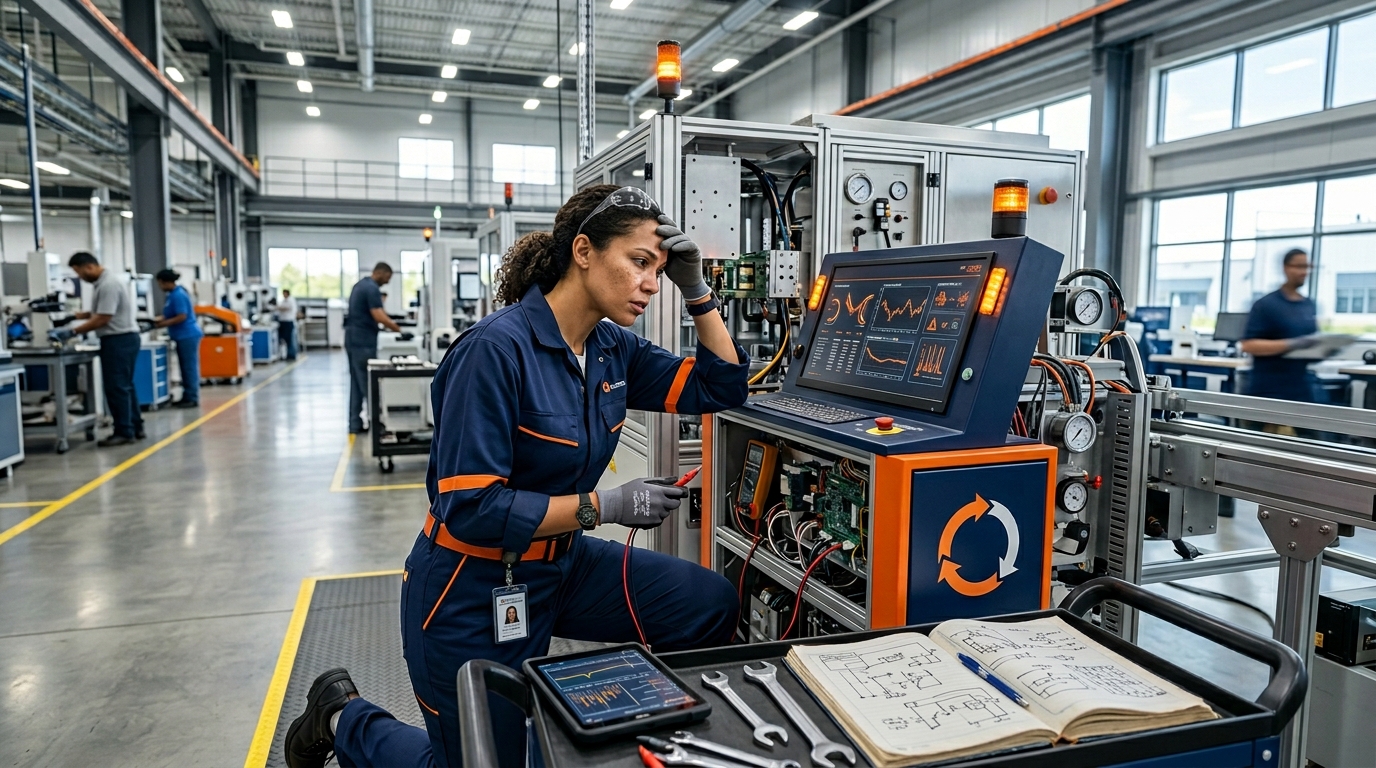
- The empirical approach (the most widespread): based on experience and intuition. Fast, but expert-dependent and hard to standardize.
- Analysis by successive trials: hypotheses are tested one by one. Methodical, but time-consuming and a source of hidden costs.
- Root cause analysis (RCA): 5 Whys, Ishikawa diagram, FMEA. Structured, but often used after the fact, rarely in field emergencies.
The limits of traditional approaches
These limits persist because data isn’t used in real time, knowledge isn’t structured and technicians often start from scratch. Diagnosis still relies on individual experience rather than collective intelligence.
The stakes of a good fault diagnosis
- Reduce MTTR: less time on identifying the cause = faster repair;
- Improve the first-time fix rate: avoid multiple interventions on the same equipment;
- Limit recurring breakdowns: address the deep causes, not just the symptoms;
- Capitalize maintenance knowledge: turn field experience into lasting knowledge.
Toward a structured, assisted and capitalized diagnosis
To reach a new level, diagnosis must evolve along three axes:
- Structured: formalized symptoms, categorized causes, standardized corrective actions;
- Assisted: suggestions of probable causes, action recommendations, access to similar cases already resolved;
- Capitalized: dynamic knowledge base, integrated feedback, continuous-improvement loop.
The role of new-generation CMMS
Traditional CMMS track and log interventions, but don’t directly help diagnose or choose the right solution. Solutions like MAINTEX integrate diagnosis as a key step of the workflow: structuring symptoms and causes, suggesting suitable actions and capitalizing field feedback. Diagnosis becomes an assisted process, no longer merely intuitive.
Identify the causes of failure faster, reduce unnecessary trials and capitalize your teams’ knowledge.
Conclusion
Improving diagnosis means acting directly on MTTR, intervention reliability and the reduction of recurring breakdowns. The most high-performing organizations no longer just manage maintenance: they structure, assist and capitalize their diagnosis. The challenge is no longer only to repair fast, but to repair correctly from the first intervention.