
Sensors, dashboards, alerts: predictive AI appeals because it promises to prevent breakdowns. But an alert is not a gain. Before investing, you need to know what you want to measure and how.
Four links not to be confused
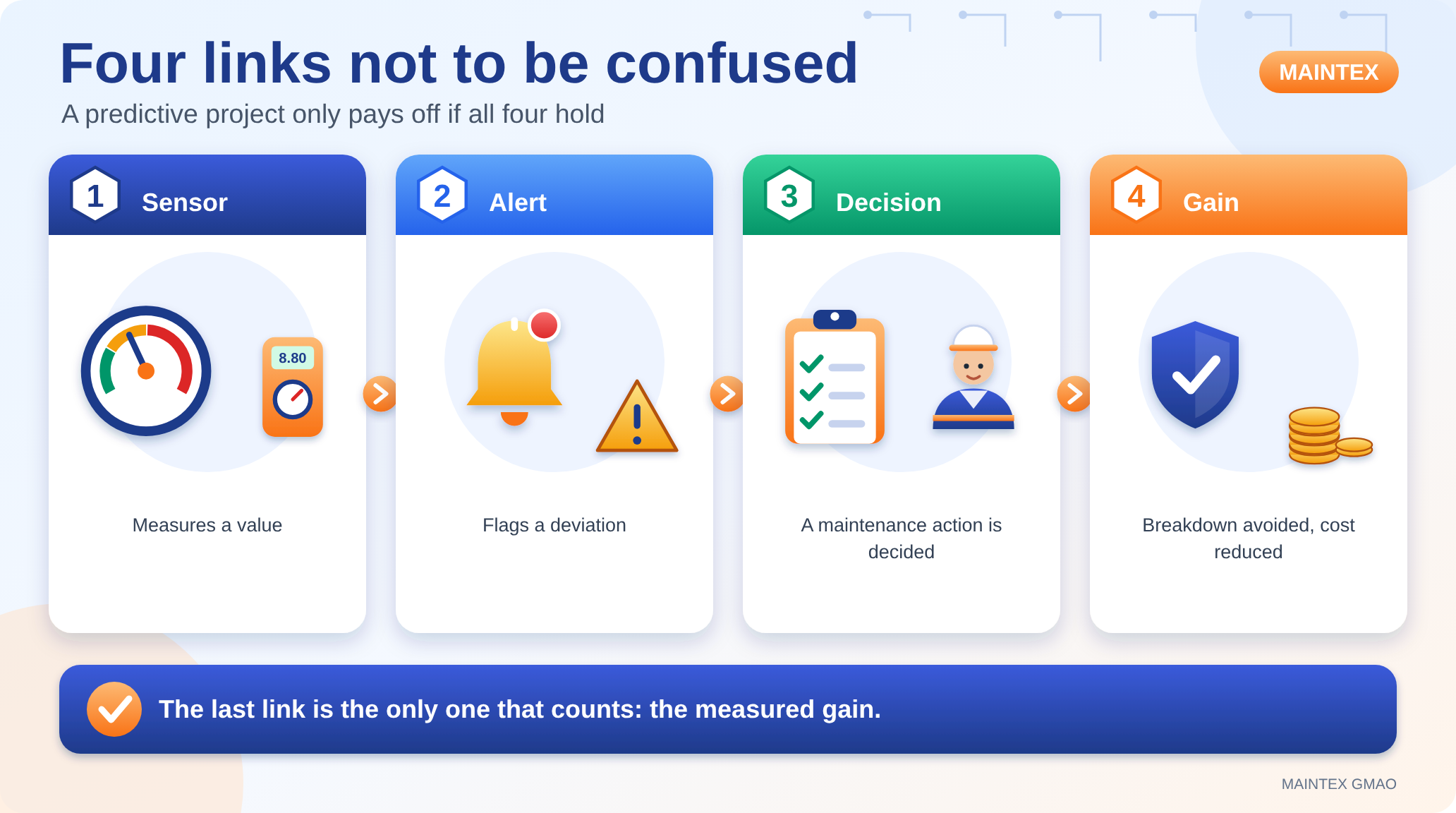
A predictive maintenance project chains four steps, and each can fail without the others showing it:
- The sensor measures something (vibration, temperature, current).
- The alert signals that a value is leaving the normal range.
- The decision turns the alert into a planned maintenance action.
- The gain is the breakdown avoided, the shutdown shortened or the cost reduced, observed over time.
We often see projects very well equipped with sensors and alerts, but with no associated decision: nobody knows what to do with the alert, or the team has no margin to step in on time. The gain then never appears, even though the investment has been made.
What research says about evaluating these technologies
In July 2025, researchers at NIST, the US National Institute of Standards and Technology, published in the Journal of Manufacturing Systems a systematic review titled “Comprehensive evaluations of condition monitoring-based technologies in industrial maintenance”. They identified 465 peer-reviewed studies between 2001 and 2023, of which 42 met the eligibility criteria.
Their conclusions call for caution. Few evaluation studies exist for manufacturing systems, unlike the energy and transport fields. Many studies lack detail on the monitoring and maintenance models used. Finally, the studies are hard to compare with one another, because of the diversity of economic analyses, performance measures and treatment of uncertainty. The authors propose structuring complete reporting elements to remedy this.
What this means for you: a gain announced by a vendor or a study cannot be directly transposed to your site. The only evaluation that counts is the one you run, with your equipment and your costs.
A decision grid for a pilot project
1Scope
One or two critical equipment items, with a usable breakdown history
2Starting situation
Availability, repair time, number of breakdowns and cost of shutdowns, measured before the project
3Associated decision
Who receives the alert, what action is planned, within what time
4Success criteria
The figures that will show the pilot succeeded, set in advance
5Duration
Long enough to observe several breakdown cycles, and no longer
6Full cost
Sensors, integration, training, team time, any subscription
7Scale-up rule
The results to reach before extending to other equipment
Measure first, scale later
A good pilot is small, measured and honest about its results. If it meets its criteria, you extend. If it does not, you understand why: unsuitable sensors, missing decision, poorly chosen equipment. In every case, the company knows where it stands, which is better than a conviction.
MAINTEX’s starting point: diagnosis
Before sensors, there is an understanding of breakdowns. MAINTEX starts from this logic: structure the diagnosis, suggest the probable causes, recommend actions and capture lessons learned. It is this foundation that then makes any predictive approach workable: without a clean history and without identified causes, no algorithm can learn much.

See how MAINTEX structures diagnosis and captures lessons learned, the basis of any predictive approach.